
Looking for fae names? This list has over 350 names for fairies, elves, sprites, and other magical beings. Every name comes with a short meaning and origin, so you can pick one for a baby, a character, a pet, or a game.
You will find names from Irish, Welsh, Scottish, Greek, Latin, and Old English stories, plus a few modern fantasy picks. Some are soft and sweet. Some are dark and wild. Try the generator first for quick ideas, then scroll through the lists to see what each name really means.
Fae Names Generator
Pick a category, click Generate, and the tool shows a fae name with its meaning. Use the Copy button to save the ones you like. The categories match the lists in this article, from male and female names to dark, cute, and Celtic ones.
Try it a few times. A name you did not plan for can turn out to be the one that fits best.
Fae Names Generator
Discover enchanting fae names for fairies, magical creatures, fantasy characters, and mystical worlds. Find a beautiful name inspired by folklore, nature, and fairy magic!
Let a little fairy magic inspire your next character, story, game, or fantasy adventure!
What Makes a Name Feel Fae?
A fae name usually feels light, old, or wild. It sounds like something from a forest, a hill, or a story told by a fire. These traits show up again and again.
- Soft sounds: names with l, n, r, and long vowels feel airy, like Niamh, Elara, or Lyra.
- Nature roots: leaves, flowers, water, and birds are everywhere in fae names, like Rowan, Bluebell, or Wren.
- Old folklore: names from Irish, Welsh, and Scottish tales carry a real fairy past.
- Light and shadow: words for dawn, moon, dusk, or mist add a magical mood.
- A bit of mystery: rare or unusual names sound like they belong to another world.
You do not need all five. One strong trait is enough to give a name that fae feel.
Fae Names Male
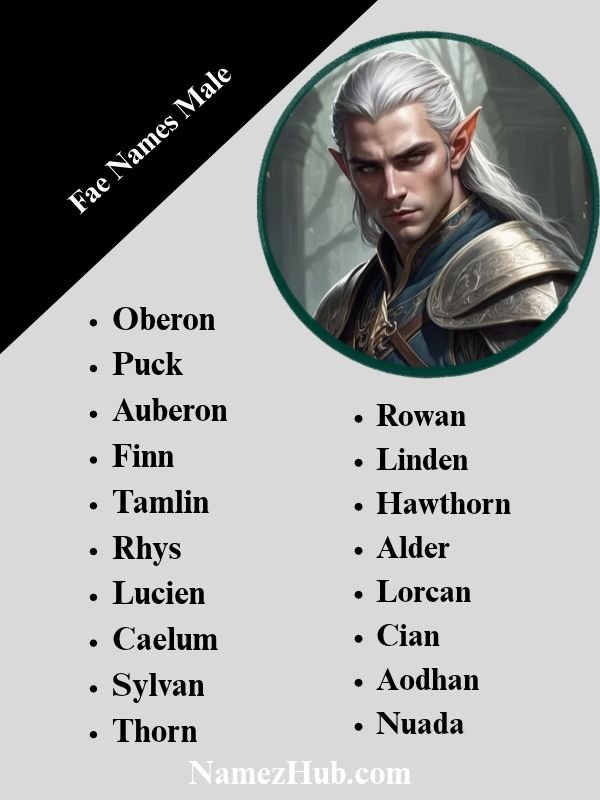
Male fae names often come from kings, tricksters, and woodland spirits. Many are tied to the Tuatha Dé Danann of Irish myth or to the fairy folk of Welsh legend.
- Oberon: king of the fairies in Shakespeare’s A Midsummer Night’s Dream (English literature)
- Puck: a mischievous fairy in English folklore (English)
- Robin: bright fame, and the sprite Robin Goodfellow (English)
- Finvarra: king of the fairy folk in Irish folklore (Irish)
- Alberich: elf ruler, a dwarf king in Germanic legend (Germanic)
- Alvis: all-wise, a dwarf in Norse myth (Old Norse)
- Lugh: bright one, a hero god of the Tuatha Dé Danann (Irish)
- Dagda: the good god, a chief of the Tuatha Dé Danann (Irish)
- Oisin: little deer, a poet who visited the land of the fairies (Irish)
- Bran: raven (Welsh and Irish)
- Gwyn: white or blessed, a king of the fairy folk in Welsh legend (Welsh)
- Arawn: king of Annwn, the Welsh Otherworld (Welsh)
- Pwyll: prudence, a prince who ruled Annwn for a year (Welsh)
- Gwydion: a Welsh magician, often linked to trees (Welsh)
- Merlin: the wizard of Arthurian legend, from Welsh Myrddin (Welsh)
- Tam Lin: a knight rescued from the Fairy Queen in a Scottish ballad (Scottish)
- Ganconer: love-talker, a fairy who charms women in Irish folklore (Irish)
- Fear Dearg: red man, a trickster fairy of Irish folklore (Irish)
- Cian: ancient or enduring (Irish)
- Manannán: a sea god tied to the Otherworld (Irish)
- Midir: a fairy king of the mound at Brí Léith (Irish)
- Aengus: true vigor, a god of love and youth (Irish)
- Sylvan: of the forest (Latin)
- Faunus: a Roman god of woods and wild places (Latin)
- Pan: a Greek god of woods and shepherds (Greek)
- Silas: of the forest, a short form of Silvanus (Latin)
- Ronan: little seal (Irish)
- Taliesin: shining brow, a bard of Welsh legend (Welsh)
- Nuada: a king of the Tuatha Dé Danann with a silver hand (Irish)
- Ogma: a god tied to eloquence and the Ogham script (Irish)
- Goibniu: a divine smith of the Tuatha Dé Danann (Irish)
Fae Names Female
Female fae names are often graceful and bright. They come from fairy queens, water spirits, and enchantresses who shaped old stories.
- Titania: queen of the fairies in Shakespeare’s A Midsummer Night’s Dream (English literature)
- Mab: a fairy queen of English folklore (English)
- Morgana: Morgan le Fay, the fairy sorceress of Arthurian legend (Arthurian legend)
- Niamh: bright or radiant (Irish)
- Aine: brightness or splendor (Irish)
- Etain: a woman of the fairy folk in an Irish tale of love and rebirth (Irish)
- Nuala: fair shoulder, short for Fionnuala (Irish)
- Cliodhna: a fairy queen and banshee of Munster (Irish)
- Rhiannon: great queen (Welsh)
- Arianrhod: silver wheel (Welsh)
- Blodeuwedd: flower face, a woman made of flowers in Welsh myth (Welsh)
- Branwen: fair raven (Welsh)
- Olwen: white footprint (Welsh)
- Ariel: an air spirit in Shakespeare’s The Tempest (English literature)
- Oonagh: a queen of the fairies in Irish folklore (Irish)
- Melusine: a water fairy of French legend (French)
- Viviane: alive, a Lady of the Lake in Arthurian tales (French)
- Nimue: a Lady of the Lake in Arthurian legend (Arthurian legend)
- Aurora: dawn (Latin)
- Sabrina: the Latin name of the River Severn, tied to a river nymph (Latin)
- Calypso: she who hides, a sea nymph in Greek myth (Greek)
- Echo: sound, a mountain nymph in Greek myth (Greek)
- Daphne: laurel, a nymph in Greek myth (Greek)
- Thalia: blooming (Greek)
- Flora: flower, the Roman goddess of blossoms (Latin)
- Ondine: little wave, a water spirit (French)
- Ceridwen: an enchantress of Welsh legend with a cauldron of wisdom (Welsh)
- Fand: a fairy woman and wife of Manannán in Irish legend (Irish)
- Selene: moon (Greek)
- Iris: rainbow, a messenger goddess (Greek)
- Maia: a mountain nymph and mother of Hermes (Greek)
- Elara: a nymph loved by Zeus (Greek)
Cute Fae Names
Cute fae names are short, sweet, and playful. Many are tiny things from the garden, like seeds, buds, and small birds. Four of them are real fairies from Shakespeare.
- Peaseblossom: a tiny fairy in A Midsummer Night’s Dream (English literature)
- Cobweb: a tiny fairy in A Midsummer Night’s Dream (English literature)
- Moth: a tiny fairy in A Midsummer Night’s Dream (English literature)
- Mustardseed: a tiny fairy in A Midsummer Night’s Dream (English literature)
- Pip: a small seed of a fruit (English)
- Pixie: a small fairy (English)
- Sprout: a young shoot of a plant (English)
- Bramble: a thorny berry bush (Old English)
- Clover: a lucky three-leaf plant (Old English)
- Daisy: day’s eye, a small white flower (Old English)
- Posy: a small bunch of flowers (English)
- Poppy: a bright red flower (Latin)
- Button: a small round fastener (English)
- Twinkle: a quick sparkle of light (English)
- Dewdrop: a drop of morning dew (English)
- Buttercup: a yellow meadow flower (English)
- Pebble: a small smooth stone (English)
- Fizz: a light bubbling sound (English)
- Wren: a tiny songbird (Old English)
- Tansy: a yellow herb with small round flowers (Latin)
- Pippin: an apple grown from seed (English)
- Thimble: a small cap worn when sewing (Old English)
- Marigold: a golden flower (English)
- Nutmeg: a warm, sweet spice (English)
- Sparrow: a small brown bird (Old English)
- Lark: a bird known for its song (Old English)
- Mote: a tiny speck of dust (Old English)
- Wisp: a thin curl of smoke or hair (English)
- Fable: a short story with a lesson (Latin, via French)
- Jingle: a light ringing sound (English)
Dark Fae Names
Dark fae names sound sharp, shadowy, or dangerous. They come from war goddesses, night spirits, and poisonous plants. They suit villains, anti-heroes, and characters with a hidden side.
- Morrigan: phantom queen or great queen, an Irish war goddess (Irish)
- Balor: evil-eyed king of the Fomorians (Irish)
- Cailleach: old woman, a hag who rules winter (Gaelic)
- Lamia: a child-stealing queen from Greek myth (Greek)
- Nyx: night, a primal goddess (Greek)
- Erebus: deep darkness (Greek)
- Hecate: a goddess of magic and crossroads (Greek)
- Nemain: frenzy, an Irish battle goddess (Irish)
- Badb: crow, a spirit of battle (Irish)
- Macha: a goddess of war and the land of Ulster (Irish)
- Sluagh: the host of restless dead in Gaelic lore (Gaelic)
- Caoineag: weeper, a Scottish spirit whose wailing warns of death (Scottish Gaelic)
- Vesper: evening (Latin)
- Raven: a black bird tied to omens (Old English)
- Thorn: a sharp spike on a plant (Old English)
- Nightshade: a poisonous plant (English)
- Hemlock: a poisonous plant (Old English)
- Belladonna: beautiful lady, a poisonous plant (Italian)
- Umbra: shadow (Latin)
- Wraith: a ghost-like figure (Scots)
- Tenebris: darkness (Latin)
- Cinder: burnt ash (English)
- Sable: black (Old French)
- Ebony: black wood (Greek)
- Onyx: a black gemstone (Greek)
- Noctis: of the night (Latin)
- Mara: a spirit that brings bad dreams (Old Norse)
- Malice: a wish to harm (Latin)
- Dusk: twilight (Old English)
- Shade: shadow (Old English)
Fae Last Names
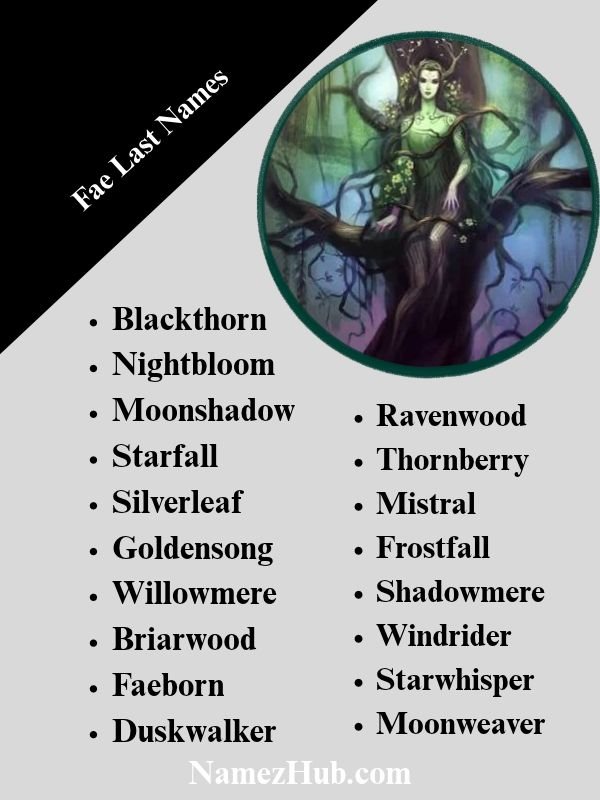
Most fae last names join two simple words, like a place and a nature word. They sound like a family from an enchanted wood. A few real English surnames fit the mood too.
- Thistlewood: a wood full of thistles (Modern fantasy)
- Moonwhisper: a soft voice under the moon (Modern fantasy)
- Starweaver: one who weaves starlight (Modern fantasy)
- Mistwalker: one who walks through mist (Modern fantasy)
- Dewhollow: a hollow filled with morning dew (Modern fantasy)
- Silverbrook: a brook that shines like silver (Modern fantasy)
- Brightwillow: a willow full of light (Modern fantasy)
- Oakenshade: shade under old oaks (Modern fantasy)
- Fernhollow: a hollow of ferns (Modern fantasy)
- Duskwing: a wing at twilight (Modern fantasy)
- Nightbloom: a flower that opens at night (Modern fantasy)
- Thornweaver: one who weaves with thorns (Modern fantasy)
- Willowmere: a pond ringed by willows (Modern fantasy)
- Glimmerbrook: a stream full of tiny lights (Modern fantasy)
- Wildmoor: a wild, open moorland (Modern fantasy)
- Greenwood: a green forest (English)
- Fairfax: fair hair (Old English)
- Everdell: a valley that never fades (Modern fantasy)
- Hawthorne: hawthorn tree (English)
- Rowanwood: a forest of rowan trees (Modern fantasy)
- Elderglen: a glen of elder trees (Modern fantasy)
- Gossamer: fine spider silk (English)
- Mossgrove: a grove covered in moss (Modern fantasy)
- Stormfeather: a feather carried by storm winds (Modern fantasy)
- Sunpetal: a petal warmed by the sun (Modern fantasy)
- Frostmere: a frozen lake (Modern fantasy)
- Briarwood: a wood of wild briars (English)
- Heatherwing: a wing the color of heather (Modern fantasy)
- Foxglove: a tall purple flower linked to fairy lore (English)
- Dawnsong: a song at first light (Modern fantasy)
Celtic Fae Names
Fairy lore is deeply Celtic. The old stories of Ireland, Wales, and Scotland gave us the Tuatha Dé Danann, the Tylwyth Teg, and many names that still sound magical today.
- Aoife: beauty or radiance (Irish)
- Brigid: exalted one, a goddess of poetry and fire (Irish)
- Danu: mother goddess of the Tuatha Dé Danann (Irish)
- Ériu: the goddess Ireland is named for (Irish)
- Banba: a goddess linked to Ireland (Irish)
- Fódla: a goddess linked to Ireland (Irish)
- Fiadh: wild or deer (Irish)
- Sorcha: brightness (Irish)
- Saoirse: freedom (Irish)
- Róisín: little rose (Irish)
- Eithne: kernel or grain (Irish)
- Tegan: fair or lovely (Welsh)
- Eira: snow (Welsh)
- Seren: star (Welsh)
- Mererid: pearl (Welsh)
- Angharad: much loved (Welsh)
- Llyr: sea (Welsh)
- Taran: thunder (Welsh)
- Emrys: immortal (Welsh)
- Idris: ardent lord (Welsh)
- Dylan: son of the sea (Welsh)
- Ciaran: little dark one (Irish)
- Fergus: man of strength (Irish)
- Conall: strong wolf (Irish)
- Fintan: white ancient (Irish)
- Lorcan: little fierce one (Irish)
- Isla: island, also a Scottish river (Scottish)
- Ailsa: from Ailsa Craig, a Scottish island (Scottish)
- Maeve: she who intoxicates (Irish)
- Tiernan: lord (Irish)
- Carys: love (Welsh)
- Gwen: white or blessed (Welsh)
- Aedan: little fire (Irish)
Fae Names With Meanings
This table shows names with their meanings and origins side by side. It is a quick way to compare names and spot the ones with a meaning you like.
| Name | Meaning | Origin |
|---|---|---|
| Aislinn | dream or vision | Irish |
| Gwennol | swallow | Welsh |
| Bryn | hill | Welsh |
| Orla | golden princess | Irish |
| Fenella | white shoulder | Scottish |
| Cathal | battle ruler | Irish |
| Darragh | oak tree | Irish |
| Ailbhe | white or bright | Irish |
| Eoghan | born of the yew | Irish |
| Lleu | light or bright | Welsh |
| Gwalchmai | hawk of May | Welsh |
| Brynmor | great hill | Welsh |
| Tegwen | fair and blessed | Welsh |
| Elfwine | elf friend | Old English |
| Alfred | elf counsel | Old English |
| Aubrey | elf ruler | Germanic, via French |
| Aelfric | elf ruler | Old English |
| Elfreda | elf strength | Old English |
| Rhian | maiden | Welsh |
Many of these names, like Alfred and Aubrey, started as elf names. The word elf is inside them. Names with elf in their roots are among the oldest fae names in English.
Also Read This: 500+ Femboy Names: Cute, Unique & Stylish Ideas (2026)
Popular Fae Names and Their Meanings

These names are popular right now and still feel magical. They are easy to say and easy to spell, which makes them a safe pick for a baby or a main character.
- Luna: moon (Latin)
- Willow: willow tree (Old English)
- Ivy: a climbing plant (Old English)
- Hazel: hazel tree (Old English)
- Juniper: an evergreen shrub (Latin)
- Faye: fairy (French)
- Fiona: white or fair (Scottish)
- Rowan: little red one, also a tree (Irish)
- Briar: a thorny wild rose bush (English)
- Ember: a glowing piece of coal (English)
- Sage: wise, also an herb (Latin)
- Aspen: a tree with trembling leaves (English)
- Lorelei: a rock on the Rhine linked to a singing siren (German)
- Ophelia: help (Greek)
- Celeste: heavenly (Latin)
- Aster: star, also a flower (Greek)
- Arden: a forest setting in Shakespeare’s As You Like It (English literature)
- Linnea: twinflower (Swedish)
- Meadow: a grassy field (Old English)
- Lavender: a fragrant purple plant (Latin)
- Violet: a small purple flower (Latin)
- Autumn: the season of falling leaves (Latin)
- Opal: a milky gemstone (Sanskrit)
- Iolanthe: violet flower (Greek)
- Seraphina: fiery one (Hebrew)
Unique and Rare Fae Names
Want something nobody else has? These names come from the many kinds of fairy folk found in stories around the world. They are rare as personal names, but each one has a clear meaning.
- Sidhe: people of the fairy mounds (Irish)
- Leanan: a fairy lover who inspires poets (Irish)
- Pooka: a shape-shifting trickster (Irish)
- Selkie: a seal who becomes a person (Scots)
- Kelpie: a shape-shifting water horse (Scottish)
- Brownie: a helpful household spirit (Scottish)
- Boggart: a household spirit that plays tricks (English)
- Hob: a friendly hearth spirit (English)
- Nixie: a river sprite (German)
- Dryad: a tree nymph (Greek)
- Naiad: a freshwater nymph (Greek)
- Oread: a mountain nymph (Greek)
- Nereid: a sea nymph (Greek)
- Sylph: an air spirit (Latin)
- Gnome: an earth spirit (Latin)
- Faun: a woodland spirit (Latin)
- Merrow: an Irish mermaid (Irish)
- Huldra: a forest woman in Scandinavian tales (Norse)
- Nisse: a farm spirit (Norse)
- Tomte: a Swedish household spirit (Swedish)
- Vila: a Slavic fairy (Slavic)
- Peri: a graceful fairy in Persian lore (Persian)
- Sprite: a small spirit (Latin)
- Elfin: like an elf (English)
- Imp: a small mischievous spirit (Old English)
- Spriggan: a guardian spirit in Cornish lore (Cornish)
- Piskie: a Cornish fairy (Cornish)
- Fata: a fairy (Italian)
- Nymph: a young nature spirit (Greek)
- Elf: a small magical being (Old English)
Nature-Inspired Fae Names
Nature is the heart of fae lore, so nature names fit best. Trees, flowers, weather, and water all give names that feel alive and a little wild.
- Alder: alder tree (Old English)
- Ash: ash tree (Old English)
- Elowen: elm tree (Cornish)
- Fern: a feathery green plant (Old English)
- Holly: holly tree (Old English)
- Heather: a purple moorland flower (Middle English)
- Laurel: a bay tree, a symbol of victory (Latin)
- Moss: a soft green plant (Old English)
- Bracken: a large fern (Middle English)
- Thistle: a prickly purple flower (Old English)
- Rue: a bitter healing herb (Latin, via French)
- Yarrow: a feathery healing herb (Old English)
- Sorrel: a tangy green herb (Old French)
- Primrose: the first flower of spring (Latin)
- Bluebell: a blue woodland flower (English)
- Snowdrop: a white winter flower (English)
- Lily: a graceful white flower (Latin)
- Orchid: an exotic flower (Greek)
- Jasmine: a sweet white flower (Persian)
- River: flowing water (English)
- Brook: a small stream (Old English)
- Storm: violent weather (Old English)
- Rain: falling water (Old English)
- Dawn: first light (Old English)
- Mist: thin fog (Old English)
- Cedar: an evergreen tree (Greek)
- Linden: lime tree (Old English)
- Maple: maple tree (Old English)
- Birch: birch tree (Old English)
- Reed: tall water grass (Old English)
- Heron: a tall wading bird (Old French)
- Fox: a clever red animal (Old English)
- Acorn: the seed of an oak (Old English)
- Elm: elm tree (Old English)
Seelie and Unseelie Fae Names
In Scottish folklore, fae belong to two courts. The Seelie Court is kind and fair, though still proud. The Unseelie Court is harsh and feared. Pick the side that fits your character.
Seelie names feel bright and gentle:
- Alba: white or dawn (Latin)
- Lucian: light (Latin)
- Clara: bright or clear (Latin)
- Aurelia: golden (Latin)
- Halcyon: calm and peaceful (Greek)
- Felicity: happiness (Latin)
- Joy: great happiness (Old French)
- Merry: cheerful (Old English)
- Bliss: deep joy (Old English)
- Solace: comfort (Old French)
- Lumen: light (Latin)
- Hope: trust in good things (Old English)
Unseelie names feel cold and sharp:
- Grim: fierce, also a nickname of Odin (Old English)
- Bane: destroyer (Old English)
- Dread: great fear (Old English)
- Vex: to trouble (Latin)
- Hex: a curse (German)
- Gaunt: thin and bony (English)
- Scathe: harm (Old Norse)
- Wolfsbane: a poisonous mountain flower (English)
- Blight: a plant disease (English)
- Fell: cruel and fierce (Old English)
- Revenant: one who returns from the dead (French)
- Hollow: empty (Old English)
- Nox: night (Latin)
Fae Queen and Royal Court Names

Every fae court needs a ruler. These names mean queen, king, crown, or noble. Some come from famous fairy royals, like the Faerie Queene in Edmund Spenser’s poem.
- Regina: queen (Latin)
- Gloriana: the Faerie Queene in Spenser’s poem (English literature)
- Una: a heroine in The Faerie Queene (English literature)
- Oriana: golden (Latin)
- Guinevere: white phantom, a queen of Arthurian tales (Welsh)
- Sovereign: a supreme ruler (Old French)
- Empress: a female ruler of an empire (Latin)
- Monarch: a single ruler (Greek)
- Regent: one who rules for another (Latin)
- Aurelian: golden (Latin)
- Reginald: ruler with counsel (Germanic)
- Rex: king (Latin)
- Basil: royal (Greek)
- Alaric: ruler of all (Germanic)
- Tiara: a jeweled crown (Latin)
- Diadem: a royal crown (Greek)
- Scepter: a ruler’s staff (Greek)
- Sapphire: a blue gemstone (Greek)
- Valdemar: famous ruler (Danish)
- Rurik: famous ruler (Old Norse)
- Roderick: famous ruler (Germanic)
- Alexandra: defender of people (Greek)
- Augustus: great or venerable (Latin)
- Octavia: eighth (Latin)
Unisex Fae Names
Fae are not tied to one gender in most stories. These names work for anyone, and many are nature words that feel light and free.
- Quinn: counsel or wise (Irish)
- Phoenix: dark red, a bird that rises from fire (Greek)
- Sky: the heavens above (Old Norse)
- Indigo: a deep blue dye (Greek)
- Haven: a safe place (Old English)
- Oakley: oak clearing (Old English)
- Finley: fair warrior (Scottish Gaelic)
- Emery: industrious (Germanic)
- Avery: elf ruler (Old English)
- Dell: a small valley (Old English)
- Hollis: holly trees (Old English)
- Wynn: fair or blessed (Welsh)
- Eden: delight (Hebrew)
- Sol: sun (Latin)
- Zephyr: west wind (Greek)
- Lux: light (Latin)
- Kestrel: a small falcon (Old French)
- Merle: blackbird (French)
- Teal: a small duck, also a blue-green color (English)
- Lyric: a song (Greek)
- Cove: a sheltered bay (Old English)
- Glen: a narrow valley (Gaelic)
- Marin: of the sea (Latin)
- Nova: new (Latin)
- Vale: valley (Latin)
Fae Names for Fantasy Characters
Writers and game masters often want a name that feels magical but is easy to say. These names come from myth and Shakespeare, so they feel rich without being hard to read.
- Thalassa: the sea (Greek)
- Caelum: sky or heaven (Latin)
- Valerian: strong, also a healing herb (Latin)
- Evander: good man (Greek)
- Corvus: raven (Latin)
- Calliope: beautiful voice, a Muse (Greek)
- Orion: a giant hunter in Greek myth (Greek)
- Andromeda: ruler of men, a princess in Greek myth (Greek)
- Elysia: from Elysium, the blessed afterlife (Latin)
- Lysandra: liberator (Greek)
- Eirian: bright or beautiful (Welsh)
- Elspeth: oath of God (Scottish)
- Isadora: gift of Isis (Greek)
- Ravenna: a city in Italy (Italian)
- Tamsin: twin (Cornish)
- Cassiopeia: a vain queen in Greek myth (Greek)
- Leander: lion man (Greek)
- Perdita: the lost one, from The Winter’s Tale (Latin)
- Miranda: worthy of wonder (Latin)
- Prospero: fortunate (Latin)
- Hermia: a young woman in A Midsummer Night’s Dream (English literature)
- Helena: torch or light (Greek)
- Demetrius: follower of Demeter (Greek)
- Hippolyta: queen of the Amazons (Greek)
- Lysander: liberator (Greek)
A good tip for fantasy: give each fae a name that matches their role. A healer might get a soft nature name. A warrior might get a short, sharp one.
How To Choose the Right Fae Name?
With so many names, it helps to have a simple plan. Follow these steps to narrow down your list.
- Decide the mood. Do you want a name that feels sweet, wild, royal, or dark?
- Pick a style. Nature names, Celtic names, and myth names each feel different.
- Check the meaning. Make sure the meaning fits the person or character.
- Say it out loud. Try it with a last name, a nickname, and a full sentence.
- Check the spelling. Names like Niamh and Saoirse look different from how they sound.
- Think about nicknames. Titania can become Tia, and Rhiannon can become Rhi.
- Sleep on it. A name that still feels right after a few days is usually the one.
If you are naming a character, also think about the world they live in. A name from a Welsh tale fits a misty hill kingdom. A Greek name fits a sunny grove.
Frequently Asked Questions
What Are Some Good Fae Names?
Good fae names often come from nature, myth, or old words. Some strong picks are Niamh, Rhiannon, Puck, Oberon, Willow, and Rowan. Browse the lists above and pick one that suits your character or child.
What Are Some Beautiful Female Fae Names?
Titania, Niamh, Aine, Rhiannon, Blodeuwedd, Melusine, and Aurora are all beautiful female fae names. Each one comes from a fairy queen, a water spirit, or a goddess of old stories.
What Are Some Powerful Male Fae Names?
Oberon, Finvarra, Gwyn, Arawn, Lugh, Dagda, and Midir are powerful male fae names. They belong to fairy kings and gods of Irish, Welsh, and English tales.
What Is the Difference Between Fae and Fairies?
Fae is a broad word for fairy folk. It comes from the Old French word for fairy. Fairies are often pictured as tiny winged beings, but the fae in old folklore include elves, selkies, brownies, pookas, and many more.
How Do I Choose a Good Fae Name?
Start with the mood you want, then pick a style such as nature, Celtic, or myth. Check the meaning, say the name out loud, and think about nicknames. Pick the one that still feels right after a few days.
Final Thoughts
Fae names carry old stories, wild places, and a little bit of mystery. From Oberon and Titania to Willow and Rowan, there is a name here for every mood and every kind of fairy.
Save the ones that catch your eye, check the meaning, and say them out loud. The right name usually feels like it was waiting for you.
